
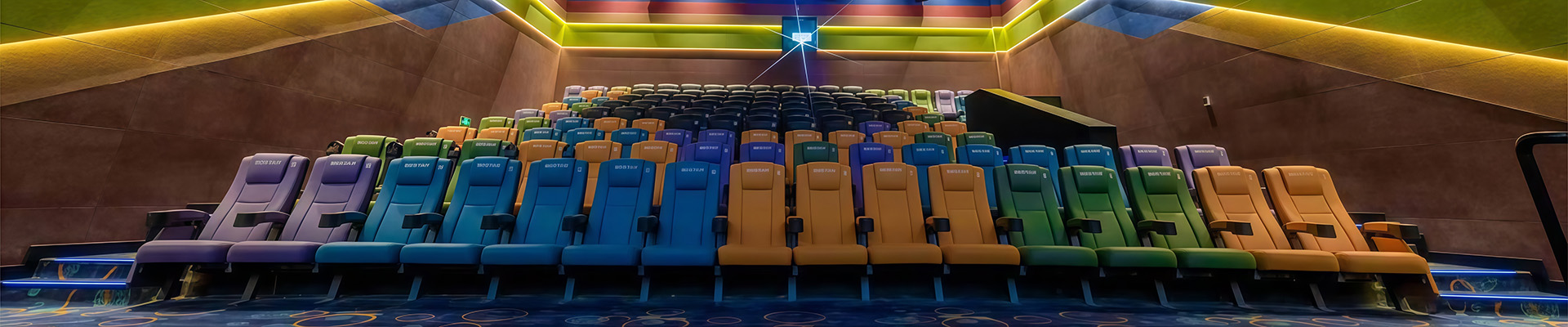
You know the old trick of tapping a watermelon to tell if it’s ripe? It’s a joke because it doesn’t work. Same with picking auditorium chairs.
Last year we interviewed a university logistics director. He told us, “I spent 800,000 on chairs three years ago. Now cushions are flat, writing boards shake, and students keep complaining to the dean.”
We asked how he chose them. “They looked good, felt soft, and were cheap,” he said.
Our reply? “That’s watermelon tapping, not chair buying.”
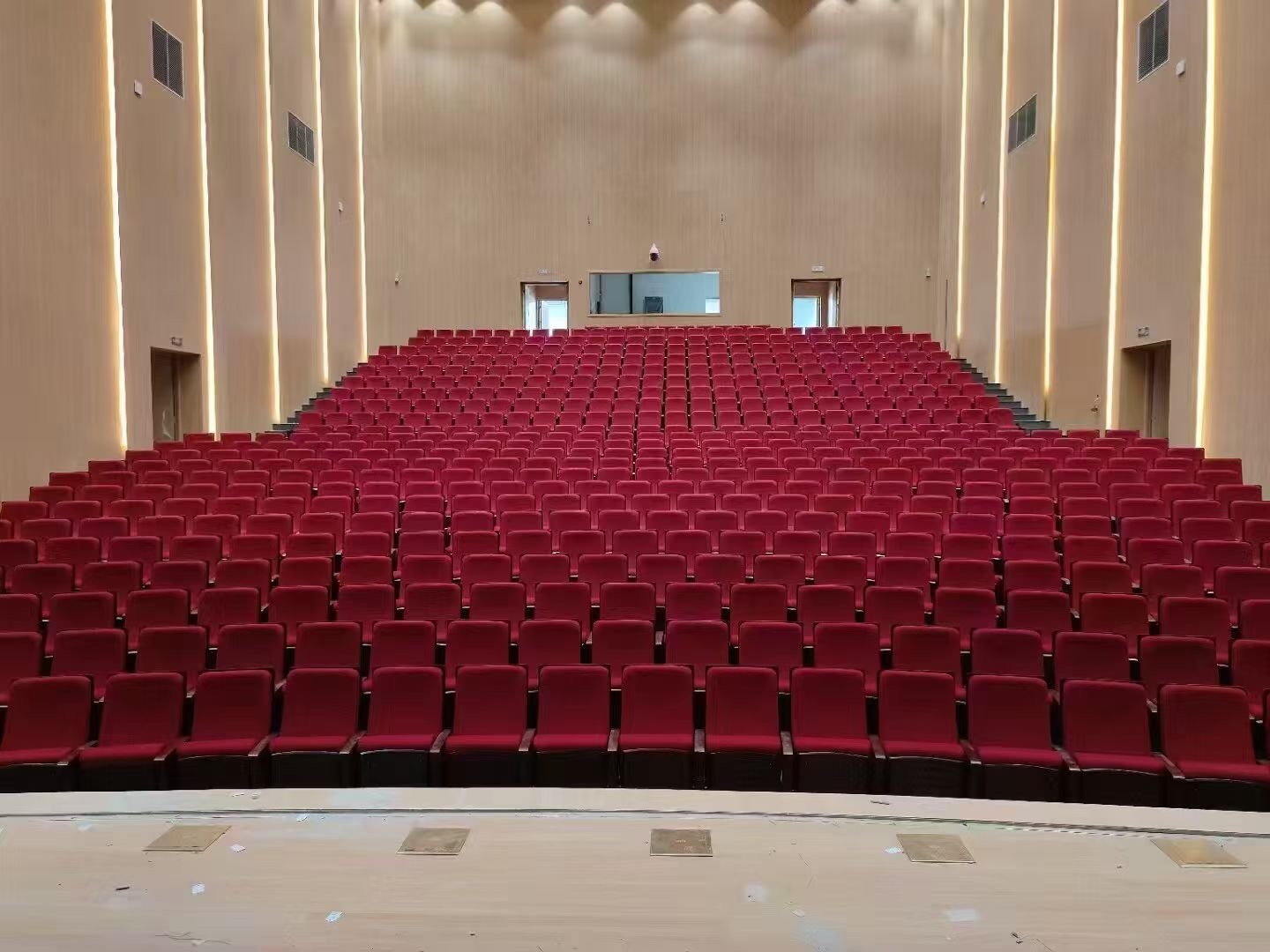
Figure 1: Auditorium chair row installation in lecture hall by STARROAD SEATING
Think about it. Your living room sofa gets one person every day. An auditorium chair gets hundreds of different people a year. Different weights. Different sitting postures. Five hundred to a thousand uses per seat.
Here are five key parameters. Most suppliers will not mention them. But each one decides if your chairs last two years or end up as scrap.
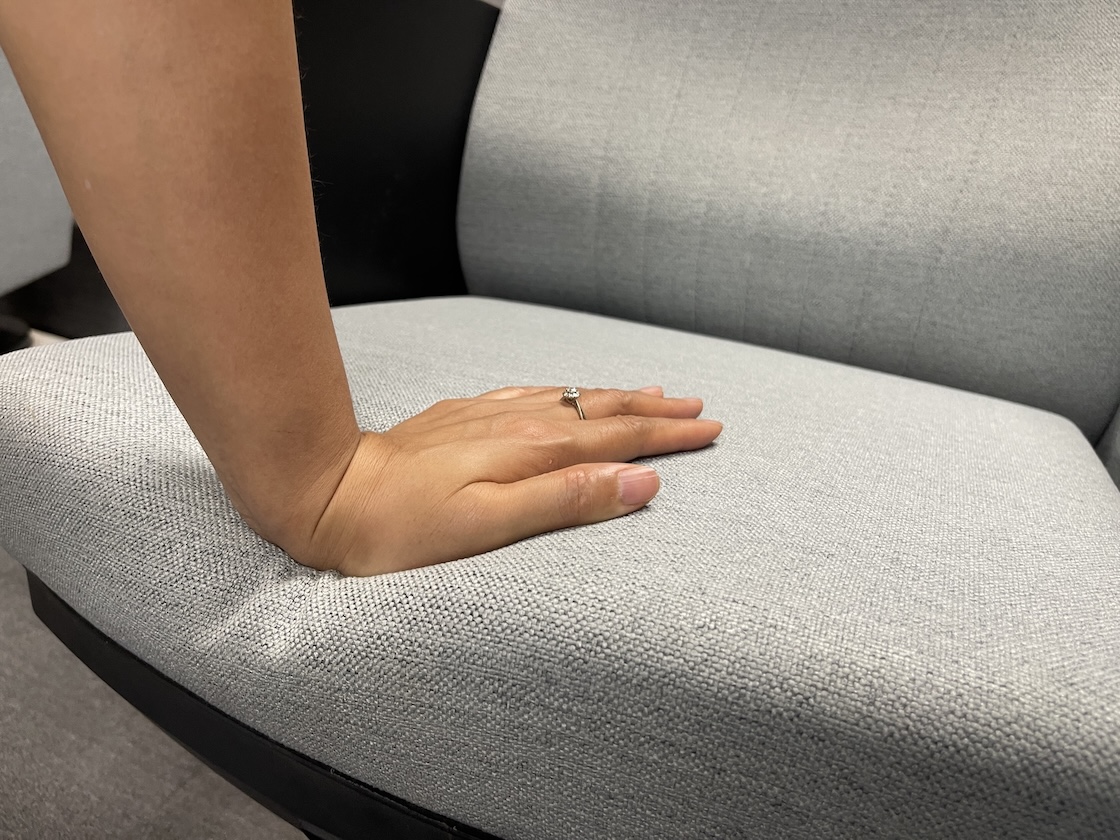
Figure 2: High resilience foam compression test on auditorium chair seat cushion
Quick self-check. Press the center of your current seat cushion hard with your palm. Does it sink more than 3cm and take more than 2 seconds to bounce back? If yes, the foam is already worn out.
Parameter 2: The hidden flaw of writing boards. Flipping up is not enough.
Many buyers only check if the writing board can flip up. They never write on it with pressure. Samples always feel stable. But the real test is this: put a 2kg laptop on it (a typical daily load), then write a few words with normal force. Does it wobble?
Industry standard. National standard GB/T 10357.3-2025, section 6.14 specifies the “additional writing board vertical static load test”. Section 6.22 specifies the “additional writing board durability test”. The test method applies a load at the farthest point from the support (the most unfavorable position), holds it for a set time, and checks for deformation.
In simple terms, pressing down hard while writing is a simplified version of a durability test. The static load test checks if it can hold weight. The durability test checks if it can survive repeated use.
Take our WL1214C auditorium chair as an example. Its writing board uses an aluminium alloy support arm (backed paint finish) plus zinc alloy black chrome plated connectors. Panel size is 360x275x9mm. We test the writing board for open-close durability and static load according to GB/T 10357.3. This ensures no wobbling or deformation over long term use. Before each batch leaves the factory, we randomly sample and test against the same standard to guarantee reliability.
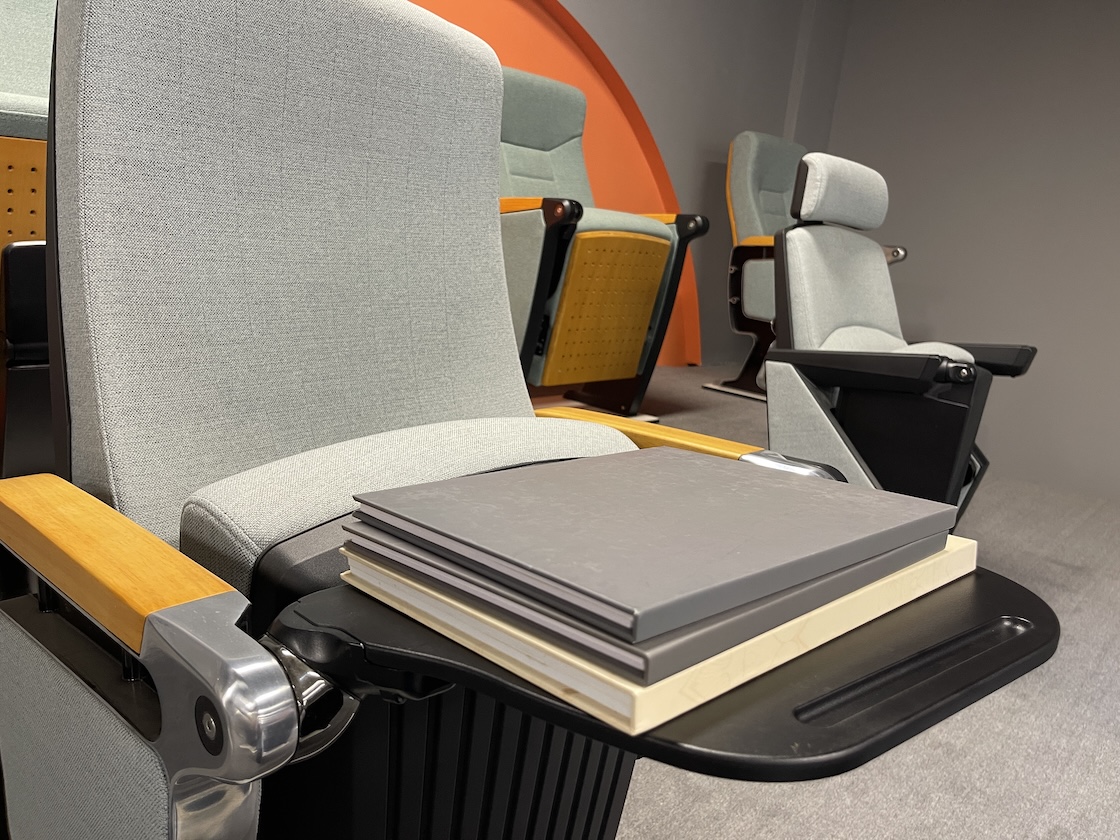
Figure 3: Writing board load test with laptop on auditorium chair by STARROAD SEATING
Quick check. Next time you visit a supplier, bring a laptop and a pen or booklets with certain weights. Put the laptop down and write a few lines with normal pressure. Does the board sink more than 3mm or wobble noticeably? If yes, reject it.
Parameter 3: Row spacing. The hidden factor for legroom.
According to JGJ57-2016, the minimum row spacing for upholstered seats in short row layout should not be less than 900mm. When row spacing is below this value, viewers around 1.75m tall will have their knees very close to or touching the seatback in front. This causes fatigue over time and makes it hard to get in and out without disturbing neighbors.
Formula:
Minimum row spacing = total chair depth (including backrest) + legroom
Total chair depth is the distance from the front edge of the seat cushion to the back of the backrest. Different models have different depths. We can provide exact numbers in product drawings or CAD layouts.
Legrrom must meet the standard. JGJ57-2016 requires that the distance from the back of one seat to the nearest part of the row behind shall be at least 300mm. So, you need at least 300mm of legroom. For better comfort, go up to 350mm or more.
To allow writing board use and to suit different body heights, we recommend a minimum row spacing of 950mm. For a more comfortable setup, use 1000-1100mm.
What we do. We provide CAD layout drawings for each product. These show total chair depth and recommend row spacing. You can plug these numbers into your auditorium length to calculate the maximum number of rows.
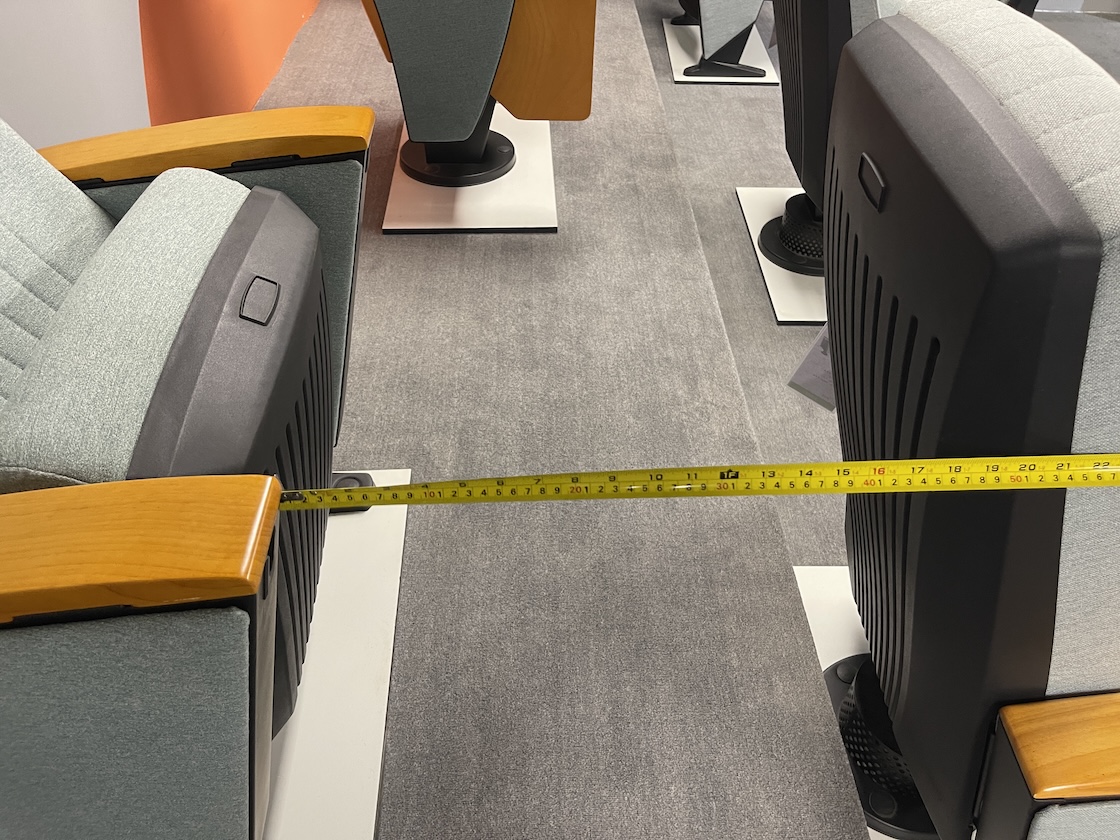
Figure 4: Measuring row spacing between auditorium chairs according to JGJ57-2016 standard
Quick check. Take a tape measure and measure the row spacing in your current hall. If it is less than 950mm, a person of average height will brush against seatbacks when passing sideways.
Parameter 4: Damping return. The bottom line for quiteness.
Many auditorium chairs make a "pop" sound when you stand up. In a quiet exam or a solemn graduation ceremony, it sounds like something breaking.
How it works. Spring return uses elastic force to snap back quickly. It is noisy and has high impact. Damping return uses hydraulic or pneumatic cushioning. The return speed is limited to 2-3 seconds. Rubber pads at contact points almost eliminate the impact sound. This is a common practice in the industry to reduce seat return noise.
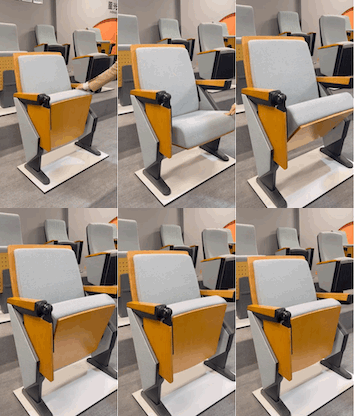
Durability requirements. According to GB/T 10357.3-2025, the combined seat and backrest durability test can reach 200,000 cycles (Level 3). This standard provides an important reference for us to evaluate long-term product reliability. Also, the strength requirements in European standards EN 12727 (for row seating) and EN 1728 (general test method) are references we look at during product design.
What we do. Before each batch leaves the factory, we randomly test seat cushion return noise with a decibel meter. We follow an industry reference standard for seat return noise: the sound from an unloaded moving part should be below 35dB (A-weighted). This ensures our products are quiet. We use high-quality gas springs and rubber pads in our damping return mechanism. Every movement is smooth. Return time stays stable at 2-3 seconds. No abnormal noise after long use.
Quick check. Stand up and let the seat cushion return naturally. If you hear a clear “click” or “pop”, or if the cushion hits the bottom with a bang, there is no damping buffer or the damper has failed.
Parameter 5: Fabric. The balance between stain resistance, breathability, and wear resistance.
Light coloured fabrics look dirty after two months. Poor quality fabrics start pilling and fading within a year. Pick the wrong fabric for high traffic areas, and cleaning costs will eat your profit.
Abrasion resistance standard. According to GB/T 19817-2005, upholstery fabrics for seating must reach at least 25,000 Martindale cycles for top grade products. We select high end knitted fabric. Its wear resistance meets the demands of high traffic venues.
For high traffic spaces such as auditoriums and lecture halls, the industry generally recommends fabrics with at least 30,000 cycles. This ensures long term use without breaking or pilling.
Breathability. Knitted fabrics allow good air flow. They keep you cool during long sitting sessions. This improves comfort during extended meetings or lectures.
Stain resistance treatment. We offer a three-proof treatment (water, oil, stain resistant). It can be tested according to AATCC 118‑2020, with an oil contact angle of at least 110°. This makes daily cleaning easy.
Quick check. Take a wet white cloth and rub the existing seat cover ten times with force. Does the cloth show obvious color transfer or stains? If yes, the fabric's colorfastness and stain resistance are poor.
Three procurement scenarios: take them and use them directly
No need to overthink very single parameter. Below are the three most common procurement scenarios. We have matched them with recommended solutions and verifiable standards.
| Scenario | Key parameters | Trade-offs | Recommended model | Verification method |
| University lecture hall (high frequency, many students, wear resistance first) | Foam density ≥45kg/m3, damped return mechanism, fabric high wear resistance | Writing tablet material (ABS is sufficient) | WL1203C-2 | Request density test report (meets GB/T 10802-2023) |
| Corporate meeting room (mostly PPT presentations, occasional writing, comfort important) | Writing tablet load capacity ≥5kg, row spacing ≥950mm | Foam density ≥40kg/m3 is acceptable | WL1212C | On-site test: put a laptop on the tablet and write with normal pressure |
| Multi-function hall (meetings + performances, zero noise tolerance) | Silent return (≤35dB), row spacing ≥1000mm, fabric stain-resistant treatment (optional three-proof finish) | Writing tablet height / position | WL1214C | Measure return noise with a decibel meter |
Comparison: Poor quality chairs vs. good quality chairs (real comparison after two years)
| Parameter | Poor quality (after 2 years) | Good quality (after 5 years) | Check method |
| Seat cushion | Sagging ≥10mm, hard feel | 75% compression set ≤8%, good resilience | Measure sagging with a ruler; check test report for compression set |
| Writing board | Wobble >5mm, sagging | No permanent deformation under ≥5kg load, no wobble | Put a 2kg weight and measure displacement; press down to test stability |
| Return mechanism | Loud "pop" (≥50dB) | Silent slow return (≤35dB) | Measure with a decibel meter in a quiet environment |
| Fabric | Pilling grade ≤2, stains penetrate | Abrasion resistance meets commercial standard (Martindale ≥30,000 cycles), easy to clean | Check Martindale test report |
| Frame | Rust, abnormal noise | No rust, solid | Check welding points and screws; inspect surface treatment |
A good chair gains value over time. A poor chair loses value. Spending a little more on a quality chair saves you a lot in replacement and complaint costs in the long run.
A ready-to-use procurement checklist
Ask your supplier these questions. Only continue if they can answer. Each question comes with a pass standard for you to judge on the spot.
1. What is the seat cushion foam density in kg/m3?
Pass: ≥45kg/m3, with a QB/T 2080-2018 test report (or density test report).
2. What material is the writing board support arm? What is its load capacity?
Pass: aluminum alloy or steel, load capacity ≥5kg (tested per GB/T 10357.3, no permanent deformation).
3. What row spacing do you recommend? Do you provide installation drawings?
Pass: minimum ≥950mm (comfortable range 1000-1100mm), with CAD layout drawings.
4. Is the seat return spring-based or damped? What is the return noise level in dB?
Pass: damped return, noise ≤35dB (measured in a quiet environment).
5. What is the fabric abrasion resistance grade? What stain treatment do you apply?
Pass: Martindale ≥25,000 cycles (top grade per national standard), with three-proof treatment certificate.
If the supplier hesitates and says “We don’t usually test that” or “Don’t worry, it’s comfortable” – that is not a professional reply. Just find another supplier.
By now, you have mastered the most critical points of auditorium chair selection
Only one question remains.
What is the biggest pain point for your project? Seat sagging? Wobbly writing board? Excessive noise? Or high cleaning costs?
Tell us your “top pain point” via WhatsApp or the contact form on this page. We will write a dedicated article to help you solve it. If we cannot provide a solution, we will offer you a free remote technical consultation.
An auditorium chair is not a watermelon. You cannot judge it by tapping on it.
Its true quality is written in the specifications. It is hidden in every sit and every stand over the next five years.
If you are selecting auditorium chairs now, save this article. The next time you meet with a supplier, open it and ask the questions one by one.
You may browse our Auditorium Chair Product Series Page. Every model is produced and tested in accordance with QB/T 2080‑2018, and product videos are available. For project‑specific selection advice, please contact us.
Appendix: Quick Reference Table of Key Data
| Parameter | Minimum acceptable | Recommended value | Reference standard |
| Seat foam density | 45 kg/m3 | 50-55 kg/m3 | QB/T 2080-2018 |
| Writing board load capacity | 5 kg | ≥5kg | Tested per GB/T 10357.3-2025 |
| Minimum row spacing | 900mm (short row, upholstered) | 1000-1100mm | JGJ57-2016, section 5.2.5 |
| Damping return time | 2-3 seconds | 2.5 sec ± 0.5 sec | Refer to GB/T 10357.3-2025 |
| Fabric abrasion resistance | 30,000 cycles | 50,000 cycles | Refer to GB/T 19817-2005 (top grade ≥25,000 cycles) |
| Return noise level | ≤40 dB | ≤35 dB | Refer to industry quietness standard |